In a full verticul crunch, you really work the abs by involving both the upper and lower body. To do it right:
1. Lie on your back and extend the legs up towards the ceiling. 2. Place hands behind your head (lightly cupping it) and contract the abs to lift the shoulder blades off the floor. 3. At the same time, press the heels towards the ceiling, creating a 'u' shape with the torso. 4. Lower down and repeat for 12-16 reps.
It may seem like the reverse crunch is for the lower abs but, remember, the rectus abdominis is one long muscle, so you can't separate upper from lower. To do this move right:
1. Lie on the floor and place hands on the floor or behind the head. 2. Bring the knees in towards the chest until they're bent to 90 degrees, with feet together or crossed. 3. Contract the abs to curl the hips off the floor, reaching the legs up towards the ceiling. 4. Lower and repeat for 12-16 reps. 5. It's a very small movement, so try to use your abs to lift your hips rather than swinging your legs and creating momentum.
This move, ranked 6th in the ACE study, emphasizes the upper part of the abs. To do it right:
1. Lie on a mat and extend the arms straight out behind the head with hands clasped, keeping the arms next to the ears. 2. Contract the abs and lift the shoulder blades off the floor. 3. Keep the arms straight and avoid straining the neck. If you feel neck pain, take one hand behind the head while keeping the other arm extended. 4. Lower and repeat for 12-16 reps.
The Torso Track is a tough exercise because it can hurt your back if you're not careful.
1. Grip the handles of the Torso Track and pull the abs in without holding your breath (as though bracing them). 2. Exhale and glide forward as far as you comfortably can. If you collapse in the middle and feel it in your back, you've gone too far. 3. Contract the abs to pull your body back. 4. Add tension by using more tension chords.
The vertical leg crunch is another effective move for the rectus abdominis and the obliques. To do it right:
1. Lie face up on the floor and extend the legs straight up with knees crossed. 2. Contract the abs to lift the shoulder blades off the floor, as though reaching your chest towards your feet. 3. Keep the legs in a fixed position and imagine bringing your belly button towards your spine at the top of the movement. 4. Lower and repeat for 12-16 reps.
The exercise ball is an excellent tool to strengthen the abs and comes out number three for working the rectus abdominis. To do it right:
1. Lie face-up with the ball resting under your mid/lower back. 2. Cross your arms over the chest or place them behind your head. 3. Contract your abs to lift your torso off the ball, pulling the bottom of your ribcage down toward your hips. 4. As you curl up, keep the ball stable (i.e., you shouldn't roll). 5. Lower back down, getting a stretch in the abs, and repeat for 12-16 reps.
The captain's chair leg raise is the second most effective move for the rectus abdominis as well as the obliques. You can do a variety of exercises on the captain's chair, which is a rack with padded arms that allows your legs to hang free and can be found in most health clubs and gyms. The key to keeping this move safe and effective is, first, to avoid swinging the legs or using momentum to bring the legs up. Second, keeping the knees bent will help you focus more on the abdominals and less on the hip flexors. To do it right:
Stand on chair and grip handholds to stabilize your upper body.
Press your back against the pad and contract the abs to raise the legs and lift knees towards your chest.
Don't arch the back or swing the legs up.
Slowly lower back down and repeat for 1-3 sets of 12-16 rep
The Bicycle exercise is the best move to target the rectus abdominis (i.e., the 'six pack') and the obliques (the waist), according to a study done by the American Council on Exercise. To do this exercise correctly:
1. Lie face up on the floor and lace your fingers behind your head. 2. Bring the knees in towards the chest and lift the shoulder blades off the ground without pulling on the neck. 3. Straighten the left leg out while simultaneously turning the upper body to the right, bringing the left elbow towards the right knee. 4. Switch sides, bringing the right elbow towards the left knee. 5. Continue alternating sides in a 'pedaling' motion for 12-16 reps.
You don't have to be a bodybuilder or professional athlete to reap the benefits of weight training. When done correctly, weight training can help you lose fat, increase your strength and muscle tone, and improve your bone density. But if done incorrectly, weight training won't give you these benefits and may even lead to injury. Why is proper weight training technique so important?
You might learn weight training techniques by watching friends or others in the gym. But sometimes what you see isn't safe. Incorrect weight training technique can lead to sprains, strains, fractures and other painful injuries that may hamper your weight training efforts.
If you're just getting started, work with a knowledgeable weight training specialist a physical therapist, athletic trainer or other fitness specialist who's familiar with proper weight training technique. If you've been using weights for a while, consider scheduling time with a trainer to demonstrate your technique and identify any changes you may need to make.
Here are some simple do's and don'ts to help you maximize your weight training program and reduce the risk of injury.
Do:
Lift an appropriate amount of weight. Start with a weight you can lift comfortably 12 to 15 times. For most people, a single set of 12 repetitions with the proper weight can build strength just as efficiently as can three sets of the same exercise. As you get stronger, gradually increase the amount of weight.
Use proper form. Learn to do each exercise correctly. The better your form, the better your results and the less likely you are to hurt yourself. If you're unable to maintain good form, decrease the weight or the number of repetitions. If you're not sure whether you're doing a particular exercise correctly, ask a personal trainer or other fitness specialist for help.
Breathe. You might be tempted to hold your breath while you're lifting weights. Don't. Holding your breath can lead to dangerous increases in blood pressure. Instead, breathe out as you lift the weight and breathe in as you lower the weight.
Seek balance. Work all of your major muscles — abdominals, legs, chest, back, shoulders and arms. Strengthen the opposing muscles in a balanced way, such as the front of the shoulder and the back of the shoulder.
Rest. Avoid exercising the same muscles two days in a row. You might work all of your major muscle groups at a single session two or three times a week, or plan daily sessions for specific muscle groups. For example, on Monday work your arms and shoulders, on Tuesday work your legs, and so on.
Don't:
Skip your warm-up. Cold muscles are more prone to injury than are warm muscles. Before you lift weights, warm up with five to 10 minutes of brisk walking or other aerobic activity.
Rush. Move the weight in an unhurried, controlled fashion. Taking it slow helps you isolate the muscles you want to work and keeps you from relying on momentum to lift the weight.
Overdo it. Remember, completing one set of exercises to the point of fatigue is typically enough. Additional sets may only eat up your time and contribute to overload injury.
Work through the pain. If an exercise causes pain, stop. Try it again in a few days, or try it with less weight.
Forget your shoes. Shoes with good traction can keep you from slipping while you're lifting weights.
Remember, the more you concentrate on proper weight training technique, the more you'll get from your weight training program.
Swimming is considered to be a healthy and relaxing activity. It tones the body and provides an excellent cardiovascular workout as well. Moreover, it also strengthens your heart muscles and improves the delivery of oxygen to the different parts of the body.
Experts and trainers opine that this sport can be of extremely great help to your health and if included in the daily regimen, it is bound to yield marvelous results.
The Health benefits of swimming
According to the U.S. Water Fitness Association (USWFA), swimming provides individuals with several physical, social and mental benefits. Some of them include improved strength and flexibility, enhanced muscular stamina and balance, a stronger heart, and better physique or figure. Apart from this, swimming also works as a fast and effective remedy for healing muscles.
Swimming also helps in weight control and can relieve your mind from stress and tension, fueling your energy level to a large extent. This is will keep you in perfect shape, physically as well as mentally. Swimming can be very beneficial to your heart, lungs, and muscles. Regular swimming builds up muscle strength and stamina, and also improves posture and flexibility.
Swimming can particularly be quite helpful for individuals who are obese, or individuals suffering from leg or lower back problems. This activity offers some aerobic benefits and unlike other weight training programs, swimming does not put strain on connective tissues.
Swimming can be a wonderful recreational activity for individuals and families. This activity can gradually increase your heart rate and stimulate your muscle activity. Moreover, swimming improves blood circulation through your muscles to help them recover, and help you relax as you glide through the water. Swimming is a great calorie burner
Swimming burns 3 calories a mile per pound of bodyweight. For instance if you weigh 150 lbs and it takes you roughly about 30 minutes to swim one mile, then you can expect to lose 900 calories in one hour. Swimming for fitness is quickly gaining a lot of popularity, as it can be a perfect activity for nearly anyone. This includes the most competitive athletes to the physically challenged individuals.
Research indicates that pregnant women benefit the most from swimming. It makes their abdominal muscles strong, which are most essential when carrying a baby. In addition, it strengthens the back and the muscles that help post-mastectomy women carry their weight more easily. According to experts, exercising in water can considerably reduce joint stiffness, high blood pressure, and discomfort, which is often associated with pregnancy. Swimming is great for recovering after surgery
After a woman has just undergone a breast surgery, doctors often suggest swimming as part of the recovery process. This is considered to be an advantageous means of exercising all the major muscle groups. It is advisable that you consult a physician before commencing an exercise program. It is very important to talk to experts as they can confirm which swimming strokes are moderate and which can be strenuous.
You don't have to be super-fit to enjoy cycling, and it's good for you!
When looking to lose weight, diets rarely work long-term, regular exercise always does. Any type of regular exercise is of benefit, but cycling is particularly good because fewer injuries occur as a result of it.
Cycling is also a great calorie user which has various benefits.
According to the British Heart Foundation, cycling at least 20 miles per week reduces the risk of coronary heart disease to less than half that for non-cyclists. Cycling at a gentle 12 mph on a flat road uses 450 kcal per hour. It also makes you feel younger and reduces stress. It is also claimed that cycling raises the speed of your metabolism for hours afterwards, so your body continues to burn calories even after exercise.
Cycling is mainly an aerobic activity (except when going uphill). This is beneficial to the lungs which expand to push as much oxygen into the body as possible and the heart which beats faster to transport this oxygen around your body. A strong heart and powerful lungs form the basis of general fitness.
Even if you cycle only a few miles per day, your muscles will gain the benefit, usually becoming trimmer and more toned. The main muscles you use when cycling are the upper thigh muscles, backside, and calf muscles.
Exercising releases what are known as endorphins into your blood - these create a feeling of contentment and happiness, therefore helping to reduce stress. Naturally, if you cycle in pleasant surroundings - your contentment level will be even greater (Extracted from cobr.co.uk)
If you’re tired of the treadmill and bored with the gym it’s time to grab yourself a rope and get skipping. It might sound like an easy option at first but you’ll soon discover that it’s a lot tougher than you think. Continuous skipping will give you a high intensity workout, and it’s great for the muscles of the upper and lower body. Just 20 minutes skipping will burn 250 calories. High Energy Workout
Skipping is an excellent cardiovascular workout and is comparable to running at 12kph when you consider the number of calories burned per minute. Skipping targets the calves, thighs, bottom, and shoulders, helping to keep these areas toned. It is a lower impact activity than running, is kinder to the joints and consequently, carries a smaller risk of injury.
Exercise On The Move
Skipping is a convenient, great value for money workout. It requires very little room and even less storage space. You can carry your rope with you for a workout anytime, anywhere! Skip in the park, inbest weight loss help your garden, or any room with a high ceiling – it’s an exercise for all-weathers. Correct Rope Length
The length of the rope should be right for your height. Stand on the centre of the rope, and lift the handles upward. The point where thehandles meet the rope should be level with your armpits. Some types of rope allow you to cut them down to size but if your rope is the wrong length don’t despair! Tie knots near the handles to make alterations – a good idea if more than one person is going to be using the same rope. The Basics- Guidelines
Wear soft-soled shoes. Jump on softer surfaces where possible (e.g. wooden floor would take preference over concrete)
The Basics on How To Skip
1. Stand tall but relaxed – breathing naturally 2. Elbows remain at waist level with arms extended sideways at about a 90 degree angle 3. Use a circular wrist motion to turn the rope 4. Hold the rope loosely, using thumb and index finder for control 5. Jump on the balls of the feet landing softly 6. Jump just high enough for the rope to pass under the feet
Sixty to seventy turns per minute is a good starting pace (roughly 1 turn per second). Skills & Tricks
Cool Down
March on the spot for thirty seconds before performing stretches for the quads, hamstrings, and calves, holding each for thirty seconds.
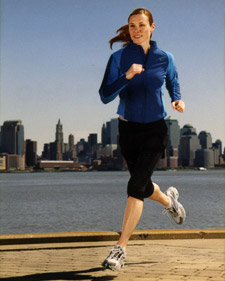
Jogging is an excellent cardiovascular exercise and is also popular because of its simplicity, adaptability to busy schedules, and the numerous benefits that can be obtained from a sound program. These include improved cardio-respiratory health, decreased risk of heart disease, decreased body fat, increased bone strength, and improved leg and back muscle endurance.
Jogging is most appropriate for women who are in moderate to good shape and who are not more than 30 pounds overweight.
Appropriate footwear is important for jogging. Choose a comfortable pair of jogging/running shoes with adequate sole cushioning, good head support, and sufficient mid-sole flexibility.
Always warm-up stretch, and cool-down during your jogging session. Begin each session by walking or jogging at a low intensity for 5-10 minutes (warm-up) and then stretch your calves, quadriceps, hamstrings, hips, and low back muscles (refer to the Flexibility Training component for the principles and techniques of stretching.) After your exercise session, cool-down by walking at a low intensity for another 5-10 minutes and then stretch the same muscles as before.
Be sure to breathe regularly throughout the exercise session.
As you jog be sure to keep your back straight , your abdominal tight, and “pump” your arms back and forth.
Refer to the WF Cardiovascular Exercise contents for the principles and guidelines of a safe and effective cardiovascular exercise program-including recommendations for duration, frequency, and intensity (and how to monitor it) of a program that is right for you and the goals you want to achieve.
For beginners (who are in moderate or better shape), jog no more than four days per week with a day of rest between workouts to allow for adequate recovery of the weight-bearing joints, ligaments, and tendons. Each exercise session should last no more than 20-30 minutes for the first 4-6 weeks.
It is also important to gradually increase the duration (the time you spend in each session) before you increase the intensity. That is, when beginning a jogging program, be more concerned with increasing the number of minutes of the exercise session before you increase the intensity, by increasing your speed or jogging hilly terrain. Interval training (explained in the Cardiovascular Exercise component) is an effective method of gradually increasing your intensity.
Refer to the WF Cardiovascular Exercise contents for the principles and guidelines of a safe and effective cardiovascular exercise program-including recommendations for duration, frequency and intensity (and how to monitor it) of a program that is right for you and the goals you want to achieve.
Cardio is really a modern term that has grown to replace aerobic exercise. To avoid the stigma of the aerobic craze of the 70s people switched to cardio when discussing it relative to fitness and strength-training programs to disassociate with the aerobics-only phenomenon.
Cardio is short for cardiovascular exercise which means really any exercise that benefits the heart. This used to be mainly aerobic training but now research suggests that weight lifting also benefits the heart - this is an example of a phrase that became popular before science could really validate it.
Aerobic exercise is any sustainable activity that utilizes oxygen (ergo the burning of fat) for a primary source of fuel. Weight lifting that is intense and in short duration will primarily use stored glycogen.
Now, this definition is muddied because you can have weight training i.e. longer sets that actually use oxygen and are therefore more aerobic (take circuit training, for example, when people aren't using a heavy load). You can also have what is traditionally thought of as cardio i.e. sprints that can be anaerobic depending on the rest. If the heart rate is allowed to lower between the intervals followed by maximum output then you are more in the anaerobic/glycolytic range. If you are only doing intervals but the heart does not drop substantially then you are going to be in more of a cardio range.
Basically, and this is a nutshell, oversimplifying because I've already gotten quite technical, there are primarily three systems that fuel energy. ALL energy systems are used to some extent, but various activity will use more of one or the other.
Anything lasting just a few seconds is going to be primarily anaerobic. This includes weight lifting, where the reps last a few seconds and are maximal bouts of output. Active rest occurs between the repetitions and then actual rest occurs between the sets. Shot-put, 50 yard-dash, weight lifting, olympic lifting, power-lifting are all examples of this.
Anything lasting a few minutes is primarily the glycolytic system where lactic acid is utilized to generate energy. This would be prolonged bouts such as sprints, longer weight lifting sets, etc. Basketball (run down court, then stay at the court = submaximal bout followed by active rest), and Soccer are examples of this.
Anything beyond that first few minutes must utilize oxygen turnover and therefore you are in the aerobic zone. This would be longer runs, rowing, hiking, etc.
Exercise is necessary to maintain good health. In fact, a regular exercise routine can reduce risk factors for developing certain illnesses and is a great way to manage any condition you may currently have. Exercise can be done by anyone at any time.
exercise is defined as a physical exertion performed in an effort to improve health, well-being and overall fitness. Obviously, exercize covers a broad spectrum of activity. In general, you can break exercise into three types
aerobic/ Cardio
anaerobic
stretching.
Aerobic/ Cardio exercise improves oxygen consumption in the body. It is what makes you sweat. Aerobic exercise, to be done properly, requires a warm-up period before and a cool-down afterwards to ensure that the heart rate stays at optimal levels throughout. According to the American College of Sports Medicine (ACSM), aerobic exercise “uses large muscle groups, can be maintained continuously and is rhythmic in nature.” Examples of aerobic exercise include: biking, swimming, jogging, walking, dancing, skiing, skating, running, rowing, rollerblading, stair climbing and more.
Anaerobic exercise, by contrast, lasts for a brief time, feature intense activity and demands more oxygen from the body than it brings into the body. Anaerobic exercise requires energy stored in the muscles. It can also be referred to any rapidly-done ‘burst of movement.’ Examples of anaerobic activities include: weight-lifting, sprints, interval training and isometrics (in which one part of the body is used to resist the movement of another part) such as Pilates.
The final category of exercise is stretching. Stretching exercises extend or lengthen the limbs, giving a person increased or added flexibility. Stretching allows you to develop a wider range of motion. Basic stretching exercises deal with specific muscle groups such as calf or hamstring stretches. Yoga, Pilates and Tai Chi have stretching elements to them. Each helps an individual develop a wider range of motion and improve his/her flexibility over time.
Of course, some exercises can fit into several categories. In order to reach and keep optimal fitness, you should incorporate movements from each type of activity in your routine. (extracted from healthtalknow.com)
There are many forms of exercise, and each type has its advantages and disadvantages. Some people prefer to exercise in a gym or at home, whereas others prefer to exercise outdoors. Some people have a very structured exercise routine, whereas others simply incorporate exercise into their lifestyle, for example, by walking rather than driving, parking farther away from their destination, or walking up stairs rather than using an elevator. Choosing the right exercise is a matter of finding an activity that helps people achieve their fitness goals and is safe, sustainable, and enjoyable (or at least tolerable). Exercise should also offer some degree of challenge; if not, then the benefits will be few.
Walking: Walking is a well-balanced form of exercise for most people, regardless of age. Many older people are able to keep fit through a regular walking program. Walking is relatively easy on the joints. During walking, at least one foot is on the ground at all times, so the force with which the foot strikes the ground is never much more than the person's weight. However, walking expends fewer calories than does running and places fewer demands on the heart. Walking slowly will not make a person very fit. To walk faster, a person can take longer steps in addition to moving the legs faster. Steps can be lengthened by swiveling the hips from side to side so that the feet can reach further forward. Swiveling the hips tends to make the toes point outward when the feet touch the ground, so the toes do not reach as far forward as they would if they were pointed straight ahead. Therefore, a person walking should always try to point the toes straight ahead. Moving the arms faster helps the feet move faster. To move the arms faster, a person bends the elbows to shorten the swing and reduce the time the arms take to swing back and forth from the shoulder. People with instability or severe joint injury may find walking difficult. Also, even vigorous walking does not strengthen the upper body and has little strengthening effect on the lower body unless the person is initially very deconditioned.
Swimming: Swimming exercises the whole body—the legs, arms, and back—without straining the joints and muscles. Often, swimming is recommended for people who have muscle and joint problems. Swimmers, moving at their own pace and using any stroke, can gradually increase endurance until they can swim for 30 minutes continuously. If weight loss is one of the main goals of exercise, however, swimming is not the best choice. Exercise out of water is more effective because air insulates the body, increasing body temperature and metabolism for up to 18 hours. This process expends extra calories after exercise as well as during exercise. In contrast, water conducts heat away from the body, so that body temperature does not rise and metabolism does not remain increased after swimming. Also, swimming tends not to build muscle, because the muscles are supported by the water, which restricts the type of movements the muscles make. And because swimming is not a weight-bearing exercise, it does not help prevent osteoporosis.
Bicycling: Riding a bicycle is good exercise for cardiovascular fitness. Pedaling a bicycle strengthens the upper leg muscles. Bicycles are pedaled in a smooth circular motion that does not jolt the muscles. A rider can enjoy the variety and challenges of different scenes and terrains. However, bicycling can be harmful in some people with knee disorders because there is greater shearing force on the knee joint than with some other activities, such as walking. Bicycling requires balance. Some people cannot maintain balance, even on a stationary bicycle, and others find the pressure of the narrow seat against the pelvis uncomfortable Also, outdoor bicycling may involve risks of cars and traffic.
With a stationary bicycle, the tension on the bicycle wheel should be set so that the rider can pedal at a cadence of 60 rotations per minute. As they progress, riders can gradually increase the tension and the cadence up to 90 rotations per minute. A recumbent stationary bicycle is both secure and comfortable. It has a contoured chair that even a person who has had a stroke can sit in. Also, if one leg is paralyzed, toe clips can hold both feet in place, so that the person can pedal with one leg. A recumbent stationary bicycle is a particularly good choice for older people, many of whom have weak upper leg muscles. Having weak upper leg muscles makes rising from a squatting position, getting up from a chair without using the hands, or walking up stairs without holding on to the railing difficult.
Aerobic Dancing: This popular type of exercise, offered in many communities, exercises the whole body. Dancing with light to moderate weights can offer extra benefit since it increases the challenge and overall demands on the muscles. People can exercise at their own pace with guidance from experienced instructors. Lively music and familiar routines make the workout fun. Committing to a schedule and exercising with friends can improve motivation. Aerobic dancing also can be done at home with videotapes. Low-impact aerobic dancing eliminates the jumping and pounding of regular aerobic dancing, thus decreasing strain on the knee and hip joints. However, the benefits of aerobic dancing, especially in terms of weight loss, are proportional to the intensity. Consequently, muscle strengthening does not increase much with this type of activity.
Step Aerobics: Step aerobics works primarily the muscles in the front and back of the upper legs (the quadriceps and hamstrings) as a person steps up and down on a raised platform (a step) in a routine set to music at a designated pace. As soon as these muscles start to feel sore, exercisers should stop, do something else, and return to step aerobics a couple of days later. High-intensity step aerobics can strain the joints, particularly the knees and hips.
Water Aerobics: Water aerobics is an excellent choice for older people and for those with weak muscles, because it prevents falls on a hard surface and provides support for the body. It is often used for people with arthritis and sometimes for injury rehabilitation. Water aerobics involves doing various types of muscle movements or simply walking in waist- to shoulder-deep water. Aerobic exercises done out of the water, however, are more effective for weight loss.
Cross-country Skiing: Cross-country skiing exercises the upper body and the legs. Many people enjoy using machines that simulate cross-country skiing, but others find the motions difficult to master and stressful around the hip joints and inner thighs (although working with shorter leg strokes often helps). Because using these machines requires more coordination than most types of exercise, a person should try out a machine before buying one. Cross-country skiing outdoors is more enjoyable to some people but adds the challenges of exercising in the cold while maintaining balance.
Rowing: Rowing strengthens the large muscles of the legs and upper arms and back. More people use rowing machines than row on water, although rowing outdoors adds the challenge of coordinating the oars and the joys of spending time in a boat. However, if the boat does not have a sliding seat, the leg muscles will not be strengthened. People who have back problems should not row without a doctor's approval.
Optimizing the effect of exercise with minimal stress
Taking basic running activity for instance, Simply keep in mind the following principles:
Consistency. You'll improve running efficiency if you do at least three half-hour runs every week, regardless of the speed at which you do them. Each additional day you run per week will slightly improve your conditioning, but it will also increase your risk of injury and fatigue. Too many running days in a row, even when you run slowly, won't give your muscles the time-out necessary for rebuilding, especially if you're 40 or older.
On the other hand, you'll start to lose conditioning if you take more than 2 days off between runs. So you need to find the number of days per week that works best for you, and be ready to reduce your running to 3 days a week if beset by tiredness, aches, or pains.
Specificity. To improve your running performance, you have to gradually increase the duration or intensity of your workouts until you are simulating your goal-race effort. So to run farther, you must run farther at least every 2 weeks. If, for instance, your goal is to finish a half-marathon, you should gradually build up your long run to about 13 miles, 2 weeks before the event. Just remember to run these long runs at about 2 minutes per mile slower than your goal race pace.
The best way I've found to increase speed is to gradually increase the number of repetitions in your weekly speed workout. The training effect for a faster 10-K, for example, is produced by starting with 6 x 400 meters, then adding another 2 x 400 meters each week until you can run 18 to 20 x 400 meters. That's a lot, but you should be running these 400s at your 10-K goal pace or slightly faster. Walk or jog at least 200 meters between repeats.
Rest. Without rest, even the most perfect workouts will not produce a training effect. If you take a day off from running after a stressful speed workout or long run, most of the damage your body incurred will be repaired in 48 hours. Everyday runners who develop tired legs can usually recover-and even increase weekly mileage-by simply running every other day.
Pace. If you run too fast on long runs or during speed sessions, you won't reap the full benefits of the training effect. The wear and tear on your body will not be repaired in time for the next long or fast workout, which makes you more fatigued rather than more efficient. Even on days when I feel good, I run my first 2 to 3 miles of any run about 2 minutes per mile slower than I could run that day.
When you run at the right pace, for enough days per week, with enough rest between runs, you'll build to a stronger level each week. After more than 4 decades of running, I feel great on almost every one of my runs because I've learned to slow down on the slow days, take off an extra day when needed, and to run regularly-including long runs and speedwork. Manage these components as I have, and you too will enjoy that wonderful phenomenon called the training effect.
Fitness is not about being thin, having a small waist, or having bulging muscles. It is a combination of qualities that enable us to be at our full potential in performing vigorous physical activities. It also means having the energy and strength to feel as good as possible. Getting more fit, even a little bit, can improve your health.
You don't have to be an athlete to be fit. Athletes reach a very high level of fitness. And people who take brisk half-hour walks every day reach a good level of fitness. Even people who can't do that much can work toward some level of fitness that helps them feel better and have more energy.
Physical Fitness involves the performance of the heart, lungs, and the muscles of the body. Specifically, it takes into account our Cardio Respiratory Endurance, Muscular Strength, Muscular Endurance, and Flexibility. To some extent, Fitness also influences our mental and emotional development since what we do with our bodies also affects what we can do with our minds.
Although Physical Fitness and good health influences each other, they are not the same. Healthy people could be physically unfit due to lack of exercise. On the other hand, Physically Fit people perform their everyday tasks effortlessly.
What are the benefits of fitness?
Fitness helps you feel better and have more energy for work and leisure time. You'll feel more able to do things like playing with your kids, gardening, dancing, or biking. Children and teens who are fit may have more energy and better focus at school.
When you stay active and fit, you burn more calories, even when you're at rest. Being fit lets you do more physical activity. And it lets you exercise harder without as much work. It can also help manage weight.
Fitness is good for your heart, lungs, bones, and joints. And it lowers your risk for heart attack, diabetes, high blood pressure, and some cancers. It also can help you to sleep better, handle stress better, and keep your mind sharp. How much physical activity do you need for health-related fitness?
To improve your health, it’s important to make physical activity part of your daily life.
One way is to get moderate activity, like brisk walking, for at least 2½ hours a week.
Or you can do vigorous exercise, like running, for at least 1¼ hours a week. This activity makes you breathe harder and have a much faster heartbeat than at rest.
Experts recommend that teens and children (starting at age 6) do moderate to vigorous activity at least 1 hour every day.
Here’s how you can tell if an activity or exercise is making you work hard enough.
If you can't talk while you do it, you're working too hard. You're at the right level if you can talk but not sing during the activity. What types of physical activity improve fitness?
The activities you choose depend on which kind of fitness you want to improve. There are three different kinds of fitness:
Flexibility is the ability to move your joints and muscles through their full range of motion. Stretching is an exercise that helps you to be more flexible.
Aerobic fitness means increasing how well your body uses oxygen. This depends on the condition of your heart, lungs, and muscles. Any activity that raises your heart rate, such as walking or running, can improve aerobic fitness.
Muscle fitness means building stronger muscles and increasing how long you can use them (called endurance). Activities like weight lifting or push-ups can improve your muscular fitness.
Make it a daily challenge to find ways to move your body. Climb stairs if given a choice between that and escalators or elevators. Walk your dog; chase your kids; toss balls with friends, mow the lawn. Anything that moves your limbs is not only a fitness tool, it's a stress buster. Think 'move' in small increments of time. It doesn't have to be an hour in the gym or a 45-minute aerobic dance class or tai chi or kickboxing. But that's great when you're up to it. Meanwhile, move more. Thought for the day: Cha, Cha, Cha…. Then do it!
About The Blog
Physical Fitness Information is simply a place to really understand all about Physical Fitness. The content is a mixture of my own experience and infos gathered from different sources. Trying my best to structure the content for the benefits of those who really cares about their health & fitness.

 In a full verticul crunch, you really work the abs by involving both the upper and lower body. To do it right: